
Football is a game of traditions and familiar journeys, but occasionally, the shifting tides of promotion and relegation create massive gaps in a fixture’s history. Page 10 of the February 2014 matchday programme highlights exactly such a gap. The headline proudly announces: “Go Ahead voor het eerst te gast in Euroborg” (Go Ahead Eagles for the first time as a guest in Euroborg).
The historical text explains the anomaly. While FC Groningen and the club from Deventer had faced each other 16 times previously on northern soil, all of those encounters belonged to a bygone era. The last time Go Ahead Eagles played an Eredivisie match in Groningen was over 18 years prior, on December 16, 1995. That match, a 0-0 draw, was played at the gritty, beloved Oosterpark stadium. Because Go Ahead had spent nearly two decades languishing in the second tier of Dutch football, they completely missed the transition of the Pride of the North to their modern concrete cathedral.
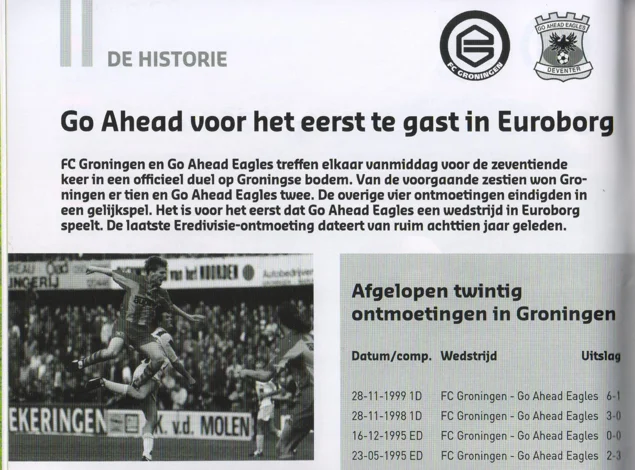
For the traveling away fans, this match wasn’t just another away day; it was a stadium tour. It marked the bridging of two distinct eras in Groningen’s history, connecting the memories of the 1990s at the Oosterpark with the modern reality of the Euroborg.
A Look into the Future
The novelty of Go Ahead Eagles visiting the Euroborg would eventually wear off, but in a positive way for the club from Deventer. While they experienced a period as a “yo-yo club” bouncing between divisions in the late 2010s, by the 2020s, they established themselves as a highly competent, stable Eredivisie side. Trips to the green-and-white stadium in Groningen once again became a regular, highly anticipated fixture on the Dutch football calendar, proving that historical gaps can always be closed with good management.