
It is hard to imagine a modern football match without thousands of fans simultaneously recording videos, checking live scores on their betting apps, or texting their friends. But this level of connectivity wasn’t always a given. Page 29 of the February 2014 matchday programme documents a monumental technological milestone for FC Groningen: the activation of a free, stadium-wide Wi-Fi network.
Under the headline “EUROBORG UITGERUST MET GRATIS WIFI-NETWERK” (Euroborg equipped with free Wi-Fi network), the club announces that visitors can now browse the internet for free during home matches. The text perfectly captures the digital priorities of 2014: “Posting messages on Facebook or Twitter, keeping friends updated via WhatsApp, or keeping track of intermediate scores on other pitches is made possible for everyone by this free service.”
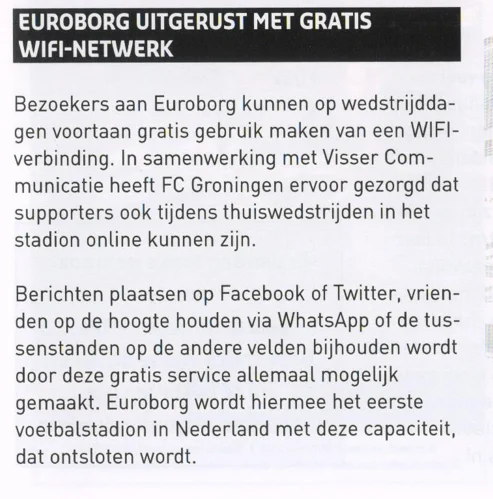
The programme proudly notes that the Euroborg, in collaboration with local partner Visser Communicatie, was the very first football stadium of its capacity in the Netherlands to unlock such a network. Before this, 22,000 people crammed into a concrete bowl meant an instant cellular dead zone. This announcement marks the exact moment the matchday experience in Groningen transitioned from a purely physical, isolated event into a globally connected, digital broadcast driven by the fans themselves.
A Look into the Future
The introduction of stadium Wi-Fi fundamentally changed fan behavior. While traditionalists argued it distracted people from the game, it became an absolute commercial necessity. By 2026, a stadium without high-speed internet is unthinkable. The infrastructure announced in this 2014 snippet paved the way for digital ticketing, in-seat food ordering apps, and the club’s own interactive platforms. The days of relying on the stadium announcer to read out the scores from other Eredivisie matches were officially over; the smartphone had conquered the terraces.