
The December 22, 2013 matchday programme was defined by mourning. As we noted from page 1, the club was reeling from the sudden death of its patriarch, Martin Koeman. While the opening pages offered emotional tributes, page 21 provided a different kind of memorial: a stark, factual timeline of his life on the pitch.
Under the header “SPELERSCARRIÈRE MARTIN KOEMAN”, the programme lists his active semi-professional career in a bird’s-eye view. It traces his journey from KFC (1957-1960) and Blauw-Wit (1960-1963) to his arrival in the north. The most crucial lines are the ones that follow: GVAV (1963-1971) and FC Groningen (1971-1973).
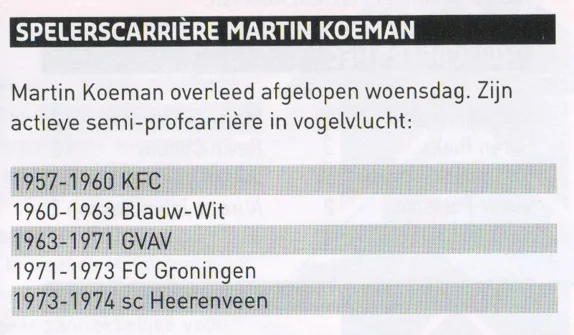
These dates are the foundational bedrock of the modern club. Martin Koeman was there during the transition from the old GVAV to the newly formed FC Groningen in 1971. He wasn’t just a staff member or a scout; he was one of the original players who wore the shirt in its infancy. The list concludes with a brief stint at sc Heerenveen (1973-1974), but his heart remained in Groningen. Seeing these dates printed in black and white on the statistics page serves as a quiet, powerful reminder that before he was a legendary scout or the father of famous sons, he was a footballer who bled for the city.
A Look into the Future
The numbers printed on this page represent only a fraction of Martin Koeman‘s true impact. His 50-year association with the club shaped its entire modern identity. Today, his legacy is physically enshrined at the Euroborg with a bronze statue and a stand bearing his family’s name. But for the historians of the game, this simple list of clubs and years—printed just days after his passing—is the definitive record of where the Koeman dynasty in Dutch football truly began.