
When the KNVB looked at the Eredivisie fixture list for November 3, 2013, they saw a glaring disciplinary problem. FC Groningen and Roda JC were about to clash at the Euroborg, and both teams were sitting dead last in the national Fair Play standings. With 25 yellow cards for the hosts and four red cards for the visitors already that season, it was a recipe for absolute chaos. To maintain law and order, the Dutch football association didn’t just send a referee; they sent a literal police officer.
Danny Makkelie, the man appointed to the middle, was famously a police inspector in the tough Rotterdam-Rijnmond region. The irony is cinematic: deploying a real-life Rotterdam cop to calm down the two most ill-disciplined, card-happy squads in the country. While the programme notes his tendency to oversee high-scoring games, his primary mission that afternoon was keeping 22 aggressive players from turning the pitch into a crime scene.
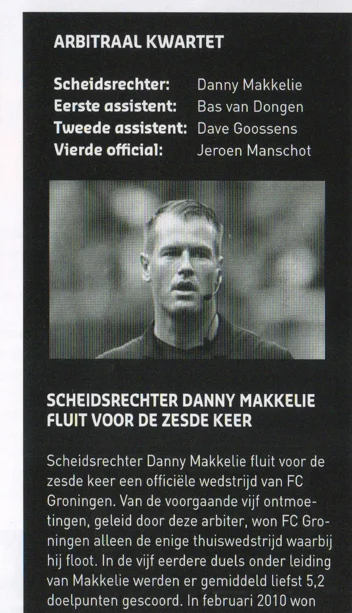
But Makkelie wasn’t policing the Euroborg alone. The “Arbitraal Kwartet” block lists his backup: assistants Bas van Dongen and Dave Goossens, and crucially, fourth official Jeroen Manschot. While Makkelie was laying down the law on the grass, it was Manschot’s job to stand between the dugouts and manage the inevitable touchline fury of the managers. For a young official, acting as the buffer in a high-stakes, high-temper fixture like this was the ultimate baptism of fire.
A Look into the Future
By 2026, the men listed in this small black box have reached the absolute pinnacle of Dutch refereeing. Danny Makkelie successfully translated his authoritative policing style to the global stage, refereeing World Cup matches, European Championships, and Champions League semi-finals. Meanwhile, the fourth official, Jeroen Manschot, didn’t stay on the touchline forever. He graduated to become a highly respected Eredivisie referee in his own right and a pioneer in the KNVB’s VAR room. This 2013 programme captures them as a young task force, deployed to keep the peace in the wild north.