
For a football referee, certain stadiums become familiar offices. When Ed Janssen walked onto the pitch to officiate the match between FC Groningen and FC Dordrecht on March 8, 2015, it marked his 11th time taking charge of a fixture inside the Euroborg. The matchday programme dedicated a specific section to his history with the club, illustrating how closely intertwined referees become with a team’s domestic narrative.
Janssen’s history with Groningen was generally associated with positive memories for the home crowd. His debut in the city was a cup tie against TOP Oss in September 2006, which Groningen won 3-2. More notably, he was the man in the middle for a resounding 5-0 demolition of FC Volendam in November 2008. Referees are often only remembered for controversial decisions, so it is a rare piece of sporting journalism to see a club organically highlight a referee’s positive or neutral track record in their official publication.
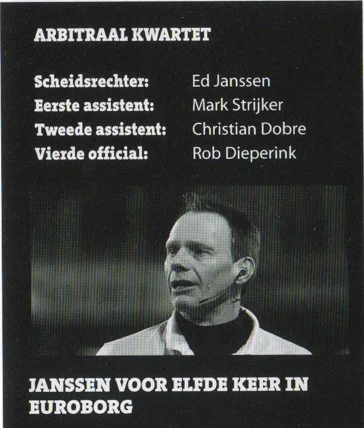
The programme also meticulously tracked Janssen’s disciplinary habits. In the 2014/2015 season leading up to this match, he had officiated 13 Eredivisie games, handing out 35 yellow cards, three direct red cards, and awarding three penalties. This level of statistical transparency provided fans with a psychological profile of the match official—suggesting a referee who wasn’t afraid to go to his pocket, but generally kept games flowing.
A Look into the Future
Ed Janssen continued to be a staple of Dutch refereeing for several more years, known for his calm demeanor and clear communication on the pitch. He officially retired from professional refereeing in 2019 after a distinguished career in the KNVB. By 2026, the refereeing landscape in the Eredivisie has been completely transformed by the introduction of VAR (Video Assistant Referee) and semi-automated offside technology. The days of a single referee’s on-pitch authority being absolute—as it was during Janssen’s prime—have been replaced by a highly scrutinized, digitally assisted ecosystem headquartered in Zeist.