
Matchday programmes usually treat international breaks as a point of immense civic pride, eagerly listing the club’s players who have been called up to represent their countries. However, page 29 of the October 2013 FC Groningen booklet reveals the harsh, emotionally draining reality of international football. For one player, the recent break wasn’t a triumph; it was the end of a lifelong dream.
Under the blunt, unforgiving headline “KIRM NIET NAAR WK” (Kirm not to the WC), the text details the fate of Groningen’s Slovenian winger, Andraz Kirm. He had traveled to join his national team for the crucial final matches of the World Cup qualification campaign, hoping to secure a ticket to Brazil the following summer. The programme clinically reports the outcome: a devastating 1-0 defeat to Switzerland in the final group match, rendering their subsequent 3-0 victory over Norway meaningless.
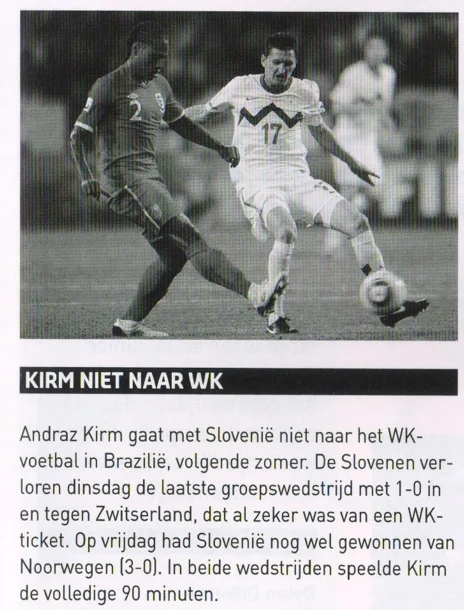
For the fans reading this in the Euroborg ahead of the PSV clash, it was a sobering reminder of the emotional baggage players carry. Kirm had played the full 90 minutes in both grueling international fixtures, experienced the ultimate sporting heartbreak, and was now expected to immediately refocus and perform in a high-stakes Eredivisie match just days later. It highlights the immense psychological resilience required at the top level of the sport.
A Look into the Future
The heartbreak documented on this page would prove to be final. Andraz Kirm never got the chance to play in a FIFA World Cup. His time at FC Groningen concluded at the end of that 2013/2014 season, leading him to a nomadic career across Europe, including stints in Cyprus and his native Slovenia. While his time in the north of the Netherlands is often remembered for his incredible work rate, this small news clipping remains a poignant artifact of the silent, personal tragedies that often unfold behind the scenes of a football season.