
When fans glance at the “Arbitraal Kwartet” (Refereeing Quartet) box in a matchday programme, they usually just want to know who to direct their frustration at for the next 90 minutes. However, page 21 of the August 2014 edition against Heracles Almelo lists a group of officials who would go on to shape the very fabric of modern, global football.
The man in the middle celebrating his 10th official match at the Euroborg was Pol van Boekel. The programme notes his previous assignments in Groningen, but Van Boekel’s true uniqueness in the refereeing world stems from his past. Unlike most officials who climb the amateur ranks, Van Boekel was a former professional footballer, having played as a defender for VVV-Venlo in the late 90s. This background gave him a distinct, player-centric approach to man-management on the pitch. He understood the dark arts, the frustrations, and the physical toll of the game because he had lived it.
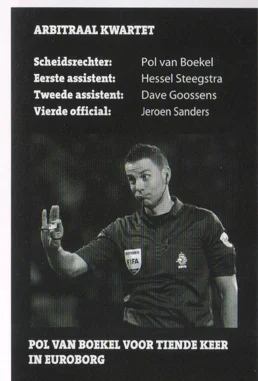
But the pedigree of this quartet didn’t stop with the main referee. Running the line as the first assistant was Hessel Steegstra. In 2014, he was a highly competent Eredivisie linesman, ensuring the offside trap at the Euroborg was correctly monitored. Little did the fans know the global stages he was destined for.
A Look into the Future
By 2026, the names in that small black box have reached the absolute pinnacle of world football. Pol van Boekel transitioned from an on-pitch referee to becoming one of UEFA and FIFA’s most trusted Video Assistant Referees (VAR). The man who blew the whistle at the Euroborg in 2014 has since sat in high-tech monitor rooms making tournament-defining decisions at World Cups and European Championships.
Meanwhile, his assistant that day, Hessel Steegstra, became a core member of Danny Makkelie’s elite refereeing team, running the line in Champions League semi-finals and World Cup knockout matches. This single page from a regular Eredivisie Sunday is a testament to the incredible, world-class standard of the KNVB refereeing pipeline.