
In Dutch football, abandoning the sacred 4-3-3 formation with three attackers is often viewed as tactical heresy. Yet, in the “De Warming Up” column of the November 2, 2014 matchday programme, FC Groningen manager Erwin van de Looi openly admitted to committing this exact heresy. This single page marks the official, public genesis of the tactical system that would ultimately win the club its first major trophy.
The headline reads “Ontwikkelingen zijn bemoedigend” (Developments are encouraging), but the opening sentence is where the real bombshell lies. “Three matches ago, FC Groningen threw the helm around and opted for a system with two instead of three strikers,” Van de Looi writes. He explains that after an unbeaten run against Excelsior, AZ, and Flevo Boys, the team was getting used to this new reality. He even details the specific micro-adjustments he made, such as changing the midfield engine room by pairing Maikel Kieftenbeld with Tom Hiariej, rather than his usual partner Rasmus Lindgren.
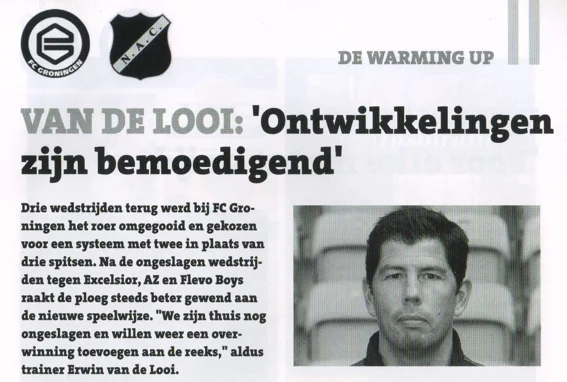
Van de Looi’s tone is pragmatic but defensive. He knew the home crowd at the Euroborg demanded entertaining, attacking football. He justifies the switch by pointing out that despite playing with two strikers, the team was creating just as many chances, if not more. “We are trying to perfect the new system and execute it better and better,” he promises the fans. It was a massive gamble for a young manager to change the club’s DNA mid-season.
A Look into the Future
Looking back from 2026, Van de Looi’s decision to “throw the helm around” was a masterstroke of pragmatic management. The 4-4-2 system he introduced here—built on a solid double pivot and lethal transitions—became the impenetrable armor of the Green-White army. It was this exact tactical setup that frustrated opponents throughout the season and ultimately led them to lift the KNVB Cup in May 2015. While purists may have grumbled in November, history vindicated Van de Looi’s tactical bravery, making this specific column a crucial artifact of club history.