
Sometimes, the most consequential news in a football club’s history is buried in a modest text column at the back of a matchday programme. On page 29 of the December 2014 edition, under the unassuming header “HERSTRUCTURERING JEUGDOPLEIDING” (Restructuring Youth Academy), FC Groningen announced a paradigm shift that would alter the club’s DNA.
The club introduced ‘Plan55’, a new football policy plan that abolished the independent U17 (B2) and U15 (C2) teams in favor of a more streamlined, elite approach. But the real headline was the man chosen to lead this revolution: Gerard Kemkers. Appointed as the manager of the Performance Center at the newly developing Sportpark Corpus den Hoorn, Kemkers was not a football man. He was a legendary Dutch speed skating coach, famous for guiding athletes like Sven Kramer to Olympic gold.
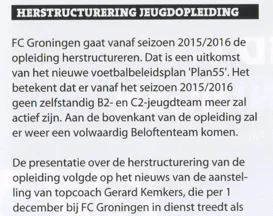
Bringing a speed skating guru into a football academy was a bold, highly scrutinized move. The programme outlines his primary objective: the project “2018: talenten op één” (2018: talents at number one). The ambitious goal was that by 2018, at least half of the first-team squad must consist of homegrown players. The club was betting that Kemkers’ expertise in elite sports psychology, physical conditioning, and marginal gains—honed on the ice rinks—could be successfully translated to the football pitch.
A Look into the Future
Looking back from 2026, the Kemkers experiment at Sportpark Corpus den Hoorn is viewed as a fascinating, albeit complex, chapter in the club’s history. While the strict target of a 50% homegrown first team by 2018 proved overly ambitious in the volatile modern transfer market, Kemkers undeniably professionalized the infrastructure and sports science approach of the academy. He introduced a top-sport mentality that transcended traditional football coaching. Though he eventually left the club, the physical legacy of his tenure—the state-of-the-art Topsportzorgcentrum at Corpus den Hoorn—remains the beating heart of FC Groningen‘s youth development today, proving that sometimes, football needs to look outside its own bubble to evolve.