
If there is one trait that has defined the managerial career of Peter Bosz, it is his unwavering, almost stubborn belief in his own attacking philosophy. Page 6 of the matchday programme from December 2014 offers a quintessential Bosz interview, perfectly capturing his mindset during his tenure at Vitesse.
At the time, Vitesse was playing arguably the most attractive football in the Eredivisie, yet they were struggling to convert performances into points, having won only four of their first fifteen matches. When confronted with FC Groningen‘s formidable unbeaten home record at the Euroborg, Bosz’s response was dripping with characteristic bravado. The headline quotes him directly: “Groningen is thuis tot dusver weliswaar nog ongeslagen, maar ze hebben nog niet tegen Vitesse gespeeld” (Groningen is unbeaten at home so far, but they haven’t played Vitesse yet).
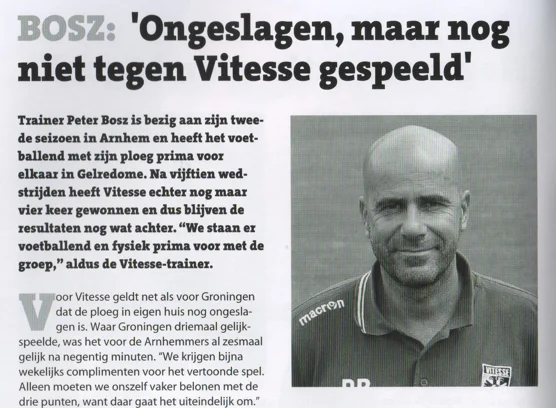
Bosz dismissed the pressure of results, focusing instead on the process. He referenced a recent 2-2 draw against FC Twente where his team played with ten men but still dominated. “We get compliments for our football almost every week. We just need to reward ourselves with the three points,” he stated. It is a fascinating glimpse into the mind of a manager who prioritizes aesthetics and dominance, regardless of the opponent or the venue.
A Look into the Future
By 2026, the footballing world is intimately familiar with “Boszball.” The philosophy he was preaching at Vitesse in 2014 eventually took him to a Europa League final with Ajax, high-profile jobs at Borussia Dortmund and Bayer Leverkusen, and ultimately, a dominant Eredivisie title win with PSV Eindhoven in 2024. Looking back at this programme, his arrogant yet charming confidence wasn’t just empty talk; it was the foundation of a tactical identity that would make him one of the most respected and entertaining Dutch managers of his generation.