
There are periods in a football club’s history where their home ground ceases to be just a stadium and transforms into a psychological fortress. As FC Groningen prepared to face AZ in early 2015, the matchday programme proudly highlighted a looming milestone: the team, under the pragmatic guidance of Erwin van de Looi, was riding a 13-match unbeaten streak in league matches at the Euroborg. Not since they lost to Feyenoord exactly a year prior had a visiting team left the Green Cathedral with three points.
This run of invincibility brought back immediate echoes of the club’s golden era. The programme explicitly reminded fans of the staggering 22-match unbeaten home run achieved across the 2005/2006 and 2006/2007 seasons under the legendary Ron Jans. To approach those numbers meant that Erwin van de Looi had successfully rebuilt the formidable aura of the stadium, a crucial element in what would become the most successful season in the club’s history.
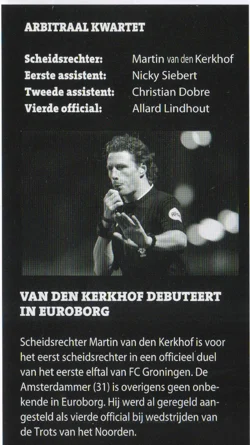
Stepping into this cauldron for his debut as a head referee at the Euroborg was 31-year-old Martin van den Kerkhof. While he had acted as a fourth official in away matches against Vitesse and FC Utrecht, taking the whistle in front of nearly 20,000 hostile, expectant northern fans during an unbeaten run was an entirely different baptism of fire. The club’s media playfully noted his Amsterdam roots, subtly ramping up the atmospheric pressure. Just pages away, idyllic advertisements for the serene, icy landscapes of Blauwestad offered a stark contrast to the boiling tension expected on the pitch.
A Look into the Future
The 2014/2015 season ended in absolute glory, with FC Groningen lifting their first major trophy, the KNVB Beker. The Euroborg fortress was a foundational pillar of that triumph. Martin van den Kerkhof survived his debut and went on to become a highly established Eredivisie referee over the next decade, a familiar face in the Dutch top flight by 2026. Blauwestad, once a heavily debated and slow-moving provincial housing project heavily advertised in these programmes, eventually matured into a highly sought-after ecological and residential success in the Oldambt region.