
Success in football often requires looking completely outside the football bubble. The 2015 season was a masterclass in cross-pollination, heavily driven by the presence of former Olympic speed skater Gerard Kemkers in the club’s management. A captivating collage of quotes in the programme highlights how this “outsider” injected a ruthless, elite top-sport mentality into the traditional football culture of FC Groningen, demanding excellence in nutrition, data, and mental focus.
While Kemkers revolutionized the back office, pure magic was happening on the pitch at De Euroborg. The media and fans were enamored with the newly dubbed “Tic-Tac Trio”—an explosive, hyper-technical midfield combination consisting of Tjaronn Chery, Albert Rusnák, and the tireless Swede, Simon Tibbling. While Kemkers provided the structural discipline, this trio provided the art, dismantling Eredivisie defenses with fluid, rapid-fire passing combinations that belonged more in Spain than in the gritty Northern Netherlands.
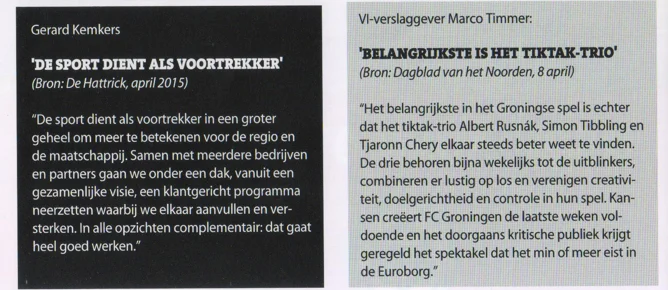
The synthesis of a speed skater’s cold, calculating pursuit of perfection and the joyous, Latin-style football played by the Tic-Tac Trio created an unstoppable momentum. The matchday programme captured this exact friction—the moment when a provincial club dared to think like global champions, creating a synergy that would soon write the greatest chapter in their history.
A Look into the Future
By 2026, the elite performance standards introduced by Gerard Kemkers have become the absolute baseline for modern football clubs across the Netherlands. Data-driven performance centers are now standard practice. As for the “Tic-Tac Trio,” they eventually scattered across the globe, playing in major leagues in the Americas, Europe, and Asia, securing their financial futures. Yet, for the fans filling De Euroborg, they will forever remain frozen in time—the three artists who, backed by the discipline of a speed skater, brought the KNVB Cup to the North.