
Usually, the away team’s squad list in a matchday programme is just a dry column of names and birthdates. However, looking at page 40 of the December 2014 edition, the Vitesse roster managed by Peter Bosz serves as a fascinating historical document of a very specific era in European football: the peak of the Chelsea loan army.
Scanning the list of players who arrived at the Euroborg that day, the influence of Stamford Bridge is glaringly obvious. In defense, there is the Brazilian right-back Wallace. In midfield, the highly touted English prospect Josh McEachran. Up front, the crown jewel of the loanees: a 19-year-old Bertrand Traoré from Burkina Faso. This wasn’t just a Dutch Eredivisie team; it was a testing ground for one of the wealthiest clubs in the world.
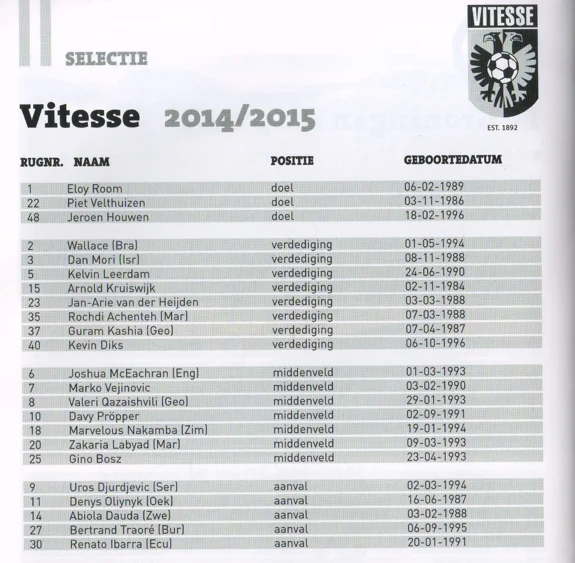
The partnership between Vitesse and Chelsea was highly controversial in the Netherlands, often criticized for distorting the competitive balance of the league. Yet, for the fans in Groningen reading this programme, it meant getting to watch future Premier League and Champions League players up close before they hit their prime. The squad list also features other incredible talents who would go on to have massive careers, such as Marvelous Nakamba and Zakaria Labyad, making this single page a goldmine of footballing potential.
A Look into the Future
By 2026, the landscape has drastically changed. The Vitesse-Chelsea pipeline, once the defining characteristic of the Arnhem club, eventually dried up following changes in ownership and stricter FIFA regulations on loan limits. The consequences for Vitesse were severe, culminating in a catastrophic 18-point deduction and relegation from the Eredivisie in 2024 due to licensing and financial irregularities tied to their former ownership structure. Meanwhile, players like Bertrand Traoré went on to play in a Europa League final for Ajax and feature in the Premier League, proving that while the satellite club model ultimately failed Vitesse, it did exactly what it was designed to do for the players.