
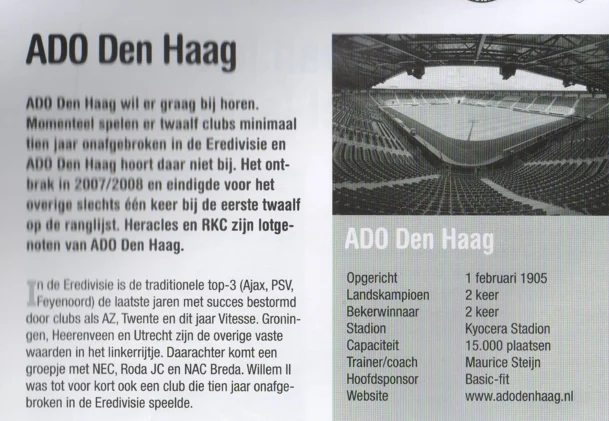
When reading the “De Tegenstander” (The Opponent) profile on page 6 of the April 2013 programme, you might expect a tactical breakdown of ADO Den Haag. Instead, the editors provided a fascinating, deep dive into the harsh financial realities of the Eredivisie. The article focuses entirely on ADO’s desperate ambition to belong to the “constant twelve”—a group of clubs that had played in the top flight for at least ten consecutive years.
Why was this 10-year metric so crucial in 2013? The text explains that the league’s budget and TV revenue distribution were determined by a new formula based heavily on a club’s performance over the past decade. Because ADO Den Haag had suffered relegation in the 2007/2008 season, they were missing from this elite financial bracket, trailing behind clubs like Heracles Almelo and RKC Waalwijk. The article highlights the brutal food chain of Dutch football: the traditional top three, followed by a stable sub-top (including FC Groningen), and then a scrap for survival among the rest. The text also throws in a spicy historical reminder, noting that ADO’s greatest recent success was beating FC Groningen in the 2011 playoff final, a wound that was still fresh for the fans in the Euroborg.
A Look into the Future
By 2026, the financial anxieties expressed in this 2013 article proved to be entirely justified. The gap in TV revenue distribution continued to dictate the fate of mid-table clubs. ADO Den Haag ultimately failed to maintain their “constant” status. Following years of boardroom chaos, controversial foreign ownership takeovers, and financial mismanagement, the proud club from The Hague suffered a devastating relegation to the Eerste Divisie. This 2013 article stands as a prophetic warning about how a single relegation can permanently derail a club’s financial trajectory in modern football.