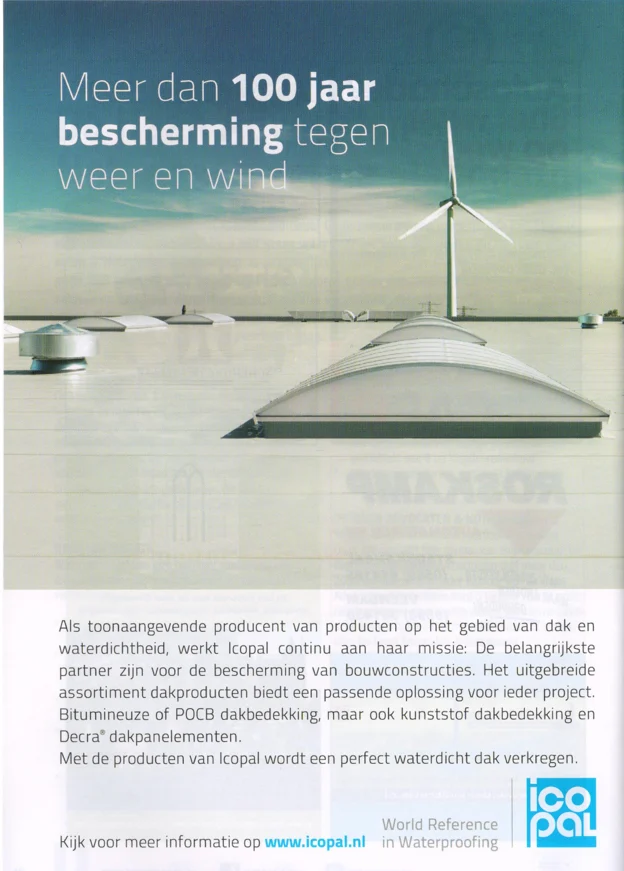
To understand the Dutch economy, you have to understand the Dutch weather. The Netherlands is a country defined by its perpetual battle against water and wind. This reality is perfectly captured on page 50 of the matchday programme, which features a sleek, full-page advertisement for Icopal, a global leader in roofing and waterproofing products.
The advertisement’s headline is highly evocative: “Meer dan 100 jaar bescherming tegen weer en wind” (More than 100 years of protection against weather and wind). Set against a backdrop of a modern flat roof and a wind turbine, the ad highlights their expertise in bituminous and synthetic roofing, as well as Decra roof panels. But why would a massive industrial manufacturer buy a full page in a football booklet? The answer lies in the scale of regional construction. The Euroborg sponsor lounges are filled with commercial real estate developers, municipal planners, and architects. When building a new hospital, a logistics hub in the Eemshaven, or a new residential block in Groningen, waterproofing is a multi-million-euro decision. Icopal used the unifying platform of FC Groningen to ensure their brand was the default choice for the region’s biggest builders.
A Look into the Future
By 2026, the roofing industry has undergone a massive ecological transformation. Driven by climate change, heavier rainfall, and urban heat islands, flat roofs in the Netherlands are no longer just waterproofed; they are “activated.” The modern descendants of the products advertised by Icopal (which later became part of the massive BMI Group) are now used as the foundation for green sedum roofs, water-retention systems, and massive solar panel arrays. The battle against “weather and wind” advertised in 2013 has evolved into a complex science of climate adaptation, making the materials protecting the buildings of the North more critical than ever.