
March 2015. The battle for survival in the Eredivisie was reaching its boiling point, and at the very bottom of the table, FC Dordrecht was in crisis mode. Just two weeks before their visit to the Euroborg, the club made the drastic decision to part ways with head coach Ernie Brandts. Thrust into the spotlight was his former assistant, Gérard de Nooijer, who was handed the monumental task of keeping the “Schapenkoppen” in the top flight.
De Nooijer’s baptism of fire was a tough 3-0 loss against league giants PSV, but the interim boss quickly stabilized the ship. The turning point arrived with a crucial, late-gasp victory over Go Ahead Eagles, a result that extended Dordrecht’s unbeaten home run to five matches and breathed new life into their campaign. Suddenly, the gap to relegation rivals NAC Breda and Heracles Almelo was reduced to a mere two and three points, respectively.
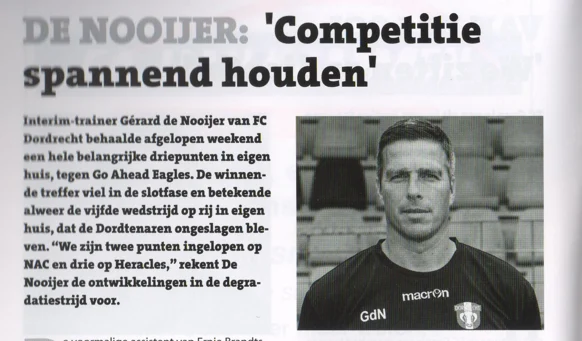
Speaking ahead of the clash with FC Groningen, De Nooijer outlined his survival blueprint. Despite the pressure, he refused to park the bus, insisting on a proactive philosophy: “We rely on our own strength, which means putting pressure on the opponent and breaking out with fast attacks.”
Interestingly, De Nooijer viewed the trip to the Euroborg not as a do-or-die battle, but as a potential bonus round. Acknowledging that Groningen was fighting for European spots and not a direct competitor in the relegation dogfight, he noted that the true “six-point matches” against Heracles and NAC were yet to come. However, the intent was clear: Dordrecht was coming to the North with nothing to lose and a squad of 22 fit players ready to fight for their Eredivisie lives.
A Look into the Future
Despite the renewed energy and the fighting spirit De Nooijer instilled in March 2015, the fairy tale did not have a happy ending. FC Dordrecht ultimately finished rock bottom of the 2014-2015 Eredivisie season with 20 points, suffering relegation back to the Eerste Divisie, where they would spend the next decade trying to rebuild. Gérard de Nooijer stepped down from his interim role at the end of the campaign, later transitioning into youth development at Sparta Rotterdam and managing various amateur sides. Yet, his brief, defiant stint trying to engineer a great escape remains a memorable footnote in Dordrecht’s modern history.