
Sometimes, the most valuable historical artifacts in a matchday programme are buried in the smallest print. On page 71, dedicated to the Junior Club, there is a short paragraph about the “Kidsplein” (Kids Square) activities before the match. The text cheerfully invites children to share their experiences: “Laat jij ons weten wat jij van het kidsplein vindt op de Hyves van Groby?” (Will you let us know what you think of the kids square on Groby’s Hyves?).
For anyone who grew up in the Netherlands in the 2000s, the word Hyves triggers an immediate, overwhelming wave of digital nostalgia. Before Facebook completely monopolized the social media landscape, Hyves was the undisputed king of the Dutch internet, famous for its dancing banana emojis and customizable profile backgrounds. Groby, the beloved polar bear mascot of FC Groningen, naturally had his own highly active profile to interact with young fans. However, the timing of this specific programme—May 2013—makes this sentence a poignant digital tombstone.
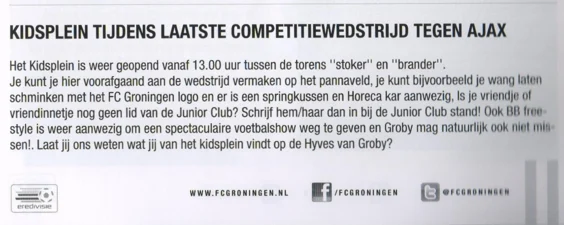
By the spring of 2013, Hyves was rapidly hemorrhaging users to Facebook. Just a few months after this booklet was printed, in December 2013, the platform officially shut down its social networking features entirely, pivoting to casual gaming before fading into obscurity.
A Look into the Future
By 2026, Hyves is nothing more than a cultural meme, a nostalgic punchline for Dutch millennials. Today, Groby the mascot entertains the newest generation of young fans through highly choreographed TikTok dances and Instagram Reels. The digital platforms where fans interact with the club change with dizzying speed, but the physical ink on this 2013 page permanently preserves the memory of the dancing banana era, capturing the exact moment right before the Dutch internet changed forever.