
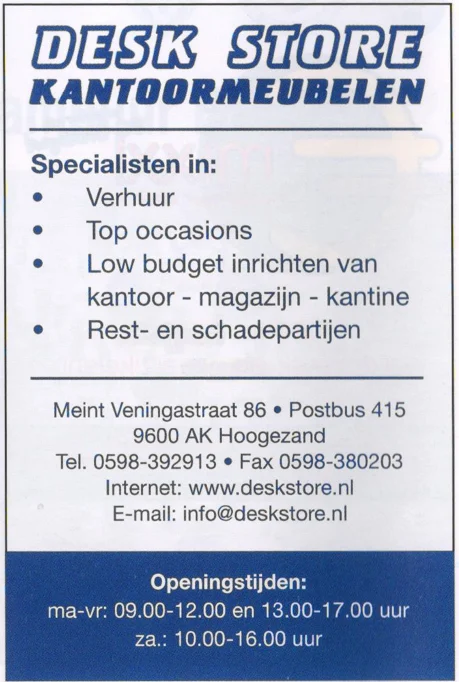
The economic hangover of the 2008 financial crisis was still very much a reality in the northern Netherlands in 2013, and the B2B advertising in the football programmes reflects this perfectly. On page 58, an advertisement for Desk Store Kantoormeubelen (Office Furniture), based in Hoogezand, offers a starkly pragmatic pitch to the local business community.
They don’t advertise luxury executive chairs or high-end mahogany desks. Instead, their bullet points proudly highlight “Low budget inrichten van kantoor” (Low budget furnishing of offices) and “Rest- en schadepartijen” (Clearance and damaged lots). In 2013, startups, local SMEs, and contractors were bootstrapping their operations. Cash flow was tight, and nobody was spending premium euros on office aesthetics. By advertising clearance and slightly damaged furniture in the Euroborg, Desk Store was speaking the exact language of the pragmatic, cost-conscious northern entrepreneur. Why buy a brand-new desk when a discounted one with a minor scratch does the job just as well?
A Look into the Future
By 2026, the concept of buying “used” or “clearance” office furniture has undergone a massive rebranding. What was advertised in 2013 purely as a “low budget” necessity driven by an economic crisis is now celebrated as the “Circular Economy.” Today, major corporations actively seek out refurbished and repurposed office furniture to meet strict corporate sustainability and ESG (Environmental, Social, and Governance) goals. The pragmatic, cost-saving business model operated by companies in Hoogezand over a decade ago was actually laying the groundwork for the modern, eco-conscious office design industry.