
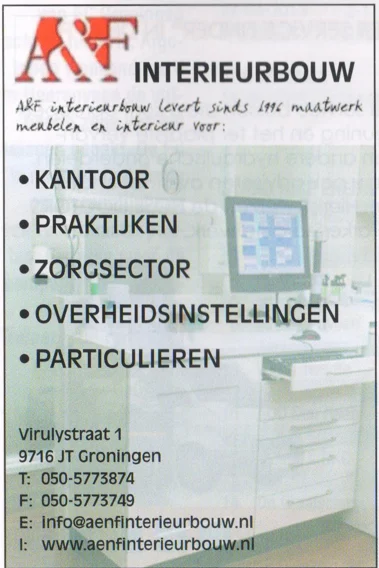
While fans focus on the green grass of the pitch, the business lounges of the Euroborg are heavily populated by the people who build the physical infrastructure of the city. On page 53, an advertisement for A&F Interieurbouw, located on the Virulystraat in Groningen, highlights a very specific, lucrative sector of the local economy: custom interior construction.
The ad lists their target sectors: “Kantoor” (Office), “Praktijken” (Medical Practices), “Zorgsector” (Healthcare), and “Overheidsinstellingen” (Government Institutions). This is not about selling a sofa to a family; this is about securing multi-million-euro contracts to outfit the interiors of new hospitals, dental clinics, and municipal buildings across the northern provinces. The healthcare and government sectors in Groningen are massive economic drivers. By maintaining a presence in the FC Groningen matchday programme, A&F Interieurbouw ensured they were rubbing shoulders with the hospital directors and municipal planners who sign off on these massive regional development budgets.
A Look into the Future
By 2026, the interior construction industry has faced a radical paradigm shift. The post-2020 normalization of hybrid and remote work meant that traditional “Kantoor” (office) spaces had to be completely redesigned, moving away from rows of desks towards flexible, collaborative meeting hubs. Furthermore, the healthcare sector (Zorgsector) in the North required massive interior adaptations to meet new pandemic-era safety and ventilation standards. The local interior builders who advertised in 2013 had to evolve from simple carpenters into experts in spatial psychology and hygienic design, physically reshaping how the people of Groningen work and heal.