
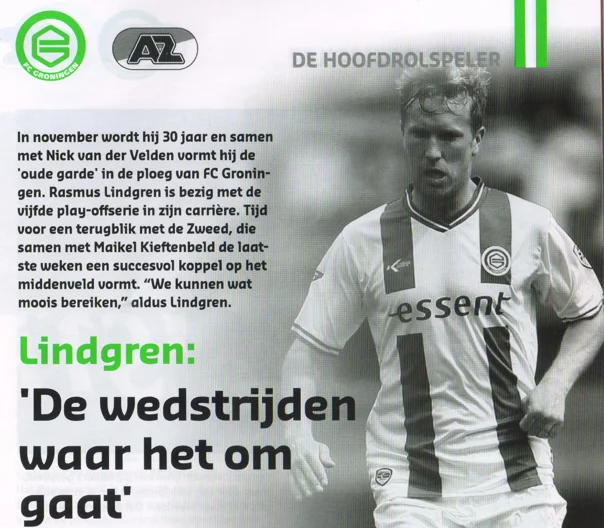
In a squad filled with young, emerging talents like Filip Kostić and Richairo Živković, the presence of a battle-hardened veteran is the ultimate stabilizing force during a playoff run. The May 18, 2014 matchday programme dedicated its “Hoofdrolspeler” feature to exactly such a player: 29-year-old Swedish midfielder Rasmus Lindgren.
Under the headline “De wedstrijden waar het om gaat” (The matches that matter), Lindgren reflects on his unique status within the squad. He was about to play in his fifth Eredivisie playoff series. “I didn’t need to explain to any of the boys what to expect,” he notes, praising the maturity of his midfield partner, Maikel Kieftenbeld. But the true value of the interview lies on page 8, where Lindgren takes the fans on a nostalgic trip back to the club’s golden European era of the mid-2000s.
He recalls the electric atmosphere of the 2006 UEFA Cup matches against Partizan Belgrade. He then shares a painful personal memory from the 2007 playoffs: “I played the last five league matches with painkillers, but due to an ankle injury I couldn’t participate in the playoffs. That was a real bummer.” He watched from the stands as a legendary Groningen side, featuring Luis Suárez and Erik Nevland, completely outclassed Feyenoord. “The European duels against Fiorentina were decided by very little, otherwise we would have reached the group stage,” he reminisces. By sharing these stories, Lindgren wasn’t just reminiscing; he was reminding the current 2014 squad of the exact European standard they were fighting to return to. He also highlights the crucial moment of the current run: “Such a stopped penalty by Marco Bizot at home against Vitesse was, for example, crucial.”
A Look into the Future
Rasmus Lindgren‘s veteran leadership paid off immensely. He successfully guided the team through the final against AZ Alkmaar, securing the European ticket he had spoken so passionately about. He remained a vital pillar of the club, eventually captaining the side to their historic 2015 KNVB Cup victory, ensuring that his name would be spoken in the same reverent tones as the legends he mentioned in this interview. After returning to Sweden to finish his playing career, his deep connection to Groningen eventually brought him back to the club in a coaching capacity, proving that his role as the bridge between eras was a permanent one.