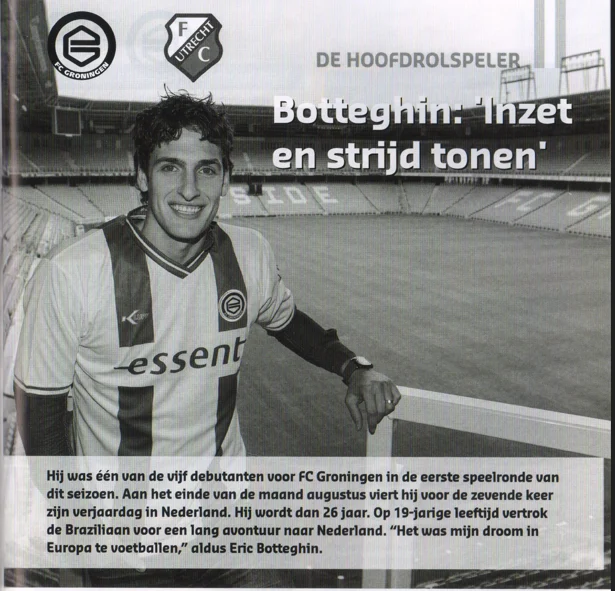
When FC Groningen signed Eric Botteghin in the summer of 2013, they weren’t just getting a central defender; they were acquiring a player who had meticulously learned the Dutch game from the ground up. The August 2013 matchday programme dedicated its main feature, “De Hoofdrolspeler”, to the Brazilian, capturing him at the exact moment he stepped onto the pitch at the Euroborg as a home player for the first time.
The interview is a delightful exploration of cultural adaptation. Celebrating his seventh year in the Netherlands, the 25-year-old Botteghin reflects on his journey from the youth academies of Gremio and Internacional to the cold pitches of FC Zwolle and NAC Breda. He humorously admits that while he still prefers warmer weather, he has become “a bit of a Dutchman,” fully embracing local culinary staples like boerenkool (traditional Dutch kale stew). “In the beginning it was strange, but now I like eating it,” he laughs.
But the most fascinating local connection revealed in the piece is his history with the city itself. Botteghin’s first-ever experience in Europe was playing in Groningen at the famous international youth tournament, Eurovoetbal. “It was a great experience. Playing against top teams from Italy, Mexico, Spain, and the Netherlands. We played the first match against FC Groningen and won the final against AZ,” he recalls. Returning to the city years later to play in the Euroborg felt like a destiny fulfilled for the boyhood Palmeiras fan.
A Look into the Future
Looking back at this interview from the perspective of 2026, Botteghin’s arrival in Groningen was a masterstroke of scouting. He didn’t just “show effort and fight” as the headline promised; he became an absolute rock at the back. His tenure at FC Groningen culminated in the legendary 2014/2015 season, where he was instrumental in winning the KNVB Cup. His stellar performances earned him a transfer to Feyenoord, where he would go on to win the Eredivisie title, cementing his legacy as one of the most successful and beloved Brazilian imports in modern Dutch football history.