
When building a digital museum of a football club’s history, reading the manager’s notes chronologically reveals the true narrative arc of a season. In the September 28, 2014 matchday programme against Willem II, manager Erwin van de Looi used his “De Warming Up” column to address a glaring, frustrating paradox in his team’s performance: they were brilliant at home, but fragile on the road.
The headline sets the immediate goal: “Thuisstatus behouden” (Maintain home status). Van de Looi proudly reflects on the fact that FC Groningen had won both of their home games so far, including a spectacular 2-0 victory over reigning champions Ajax. “That was a beautiful match where everything fell our way,” he recalls. However, the tone quickly shifts when discussing their away form. Following a grueling Europa League qualification campaign, the team had suffered three consecutive away defeats in the Eredivisie against ADO Den Haag, SC Cambuur, and FC Utrecht.
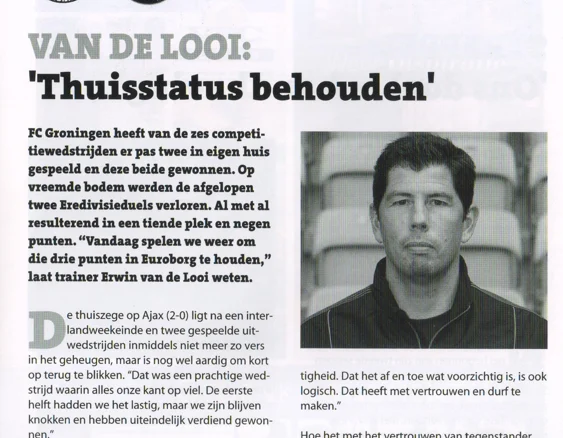
Van de Looi openly admits the team is searching for its footing. “We have shown in the recent past that we can play very attractive and attacking football. You notice that the team is searching for that feeling again and is in need of stability,” he writes. He acknowledges that the team’s play was sometimes overly cautious, attributing it to a lack of confidence and daring.
A Look into the Future
Viewed from the perspective of 2026, this column is a fascinating piece of foreshadowing. The “search for stability” that Van de Looi describes here in late September is exactly what led to his radical, highly scrutinized decision to abandon the 4-3-3 system and switch to a 4-4-2 formation just a few weeks later in October (the famous “Erfurt Experiment”). The struggles documented on this page were the necessary growing pains. By identifying the team’s fragility early on, Van de Looi laid the groundwork for the tactical revolution that would ultimately turn the Euroborg into an absolute fortress and secure the 2015 KNVB Cup.