
When a manager completely overhauls a team’s tactical system mid-season, the success of that gamble rests entirely on the shoulders of the senior players. In the October 2014 matchday programme against Excelsior, directly mirroring manager Erwin van de Looi’s announcement of the shift to a 4-4-2 formation, the “De Hoofdrolspeler” feature gave the floor to the undisputed leader of the defense: Eric Botteghin.
The Brazilian center-back, who hadn’t missed a single league start since arriving at the Euroborg, offered a calm, pragmatic perspective on the sudden tactical revolution. “Today we are going to play differently,” Botteghin stated simply. Acknowledging the secret friendly in Erfurt and the painful loss to Feyenoord that prompted the change, he explained the practical implications for the backline. “The way of building up is therefore somewhat different, but that is no drastic change. We have all chosen this and believe in it.”
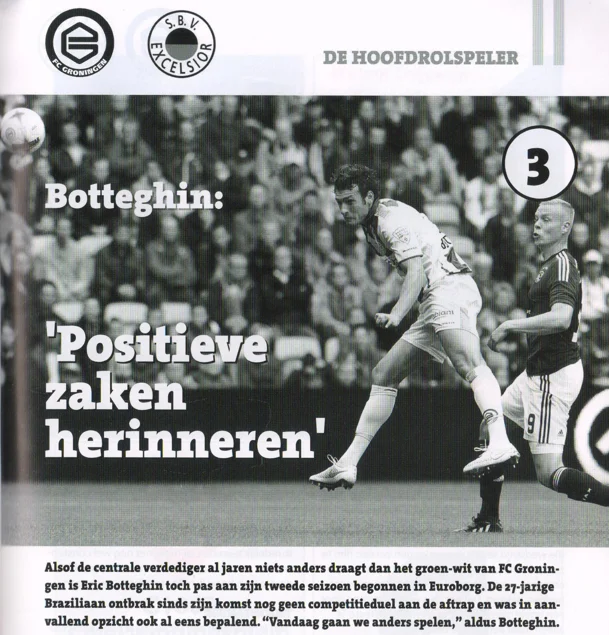
The interview also highlights the sheer physical and mental resilience of the Brazilian. He recounts fighting a red card in Zeist (the KNVB headquarters) just to be able to play against Vitesse, and fondly remembers scoring a winning goal on his birthday. However, for this specific match against Excelsior, Botteghin faced an additional challenge: his trusted defensive partner, Johan Kappelhof, was suspended. “We are used to each other, but the tasks are clear for every player,” he noted, projecting the quiet confidence that made him such a beloved figure among the fans.
A Look into the Future
Viewed from 2026, Botteghin’s calm acceptance of the 4-4-2 system in this interview is a crucial piece of club history. He didn’t panic; he adapted. This new system, built on a solid defensive block, allowed Botteghin to shine even brighter. He became the absolute bedrock of the team that went on to win the 2015 KNVB Cup. His dominant performances in this system eventually earned him a transfer to Feyenoord, where he would win the Eredivisie title and become a cult hero in Rotterdam. But looking at this 2014 programme, it is clear that his tactical intelligence and leadership were already fully formed in the North.