Football is a volatile industry, but few managerial appointments are as absurd and romantic as the one detailed on page 6 of the November 2014 matchday programme. The “De Trainer” column features an interview with Eric Hellemons, the interim head coach of the visiting team, NAC Breda. His path to the Euroborg dugout that day was nothing short of cinematic.
Hellemons explains that after his former club, RBC Roosendaal, went bankrupt in 2011, he fell out of professional football. He was coaching a local amateur side and had taken a job in the construction sector (“bouwsector”). Then, out of nowhere, NAC Breda called him to coach their U15s (C1). Shortly after, following the firing of head coach Nebojsa Gudelj, Technical Director Graeme Rutjes asked him to take over the first team. “I hadn’t stopped working in the construction sector,” Hellemons reveals. “On Saturday I had an interview, on Sunday I said ‘yes’, and from Monday I was standing in front of the group in Breda for twenty hours a week.”
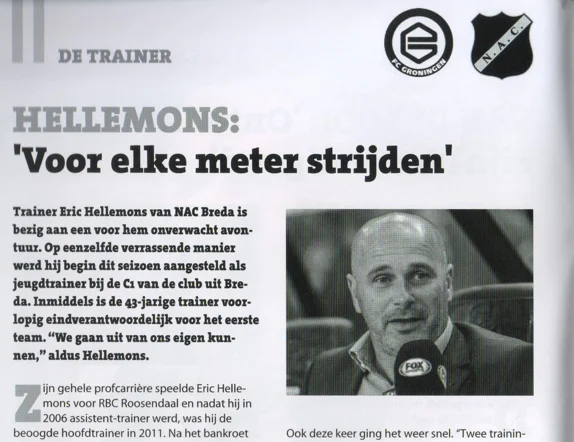
Adding a beautiful layer of narrative to the upcoming match, Hellemons mentions a specific player in the opposition ranks: FC Groningen‘s star playmaker, Tjaronn Chery. Hellemons had been an assistant coach at RBC Roosendaal when a young Chery was developing there. “It’s nice to see Tjaronn Chery again today,” he notes. “As an assistant at RBC, I contributed a tiny bit to his formation, and he has undergone a fantastic development since then.”
A Look into the Future
By 2026, the story of Eric Hellemons serves as a stark reminder of the chaotic nature of Dutch football management. His stint as interim manager at NAC Breda was a brief, turbulent chapter in a season that ultimately saw the historic club relegated from the Eredivisie. However, his pride in helping develop Tjaronn Chery was entirely justified. Chery would go on to win the KNVB Cup with Groningen that very season before embarking on a highly lucrative global career. Hellemons’ journey from a construction site to facing his former protégé in a top-flight stadium is a quintessential piece of footballing folklore.